Pages

Showing posts with label YA. Show all posts

Monday, 21 April 2014

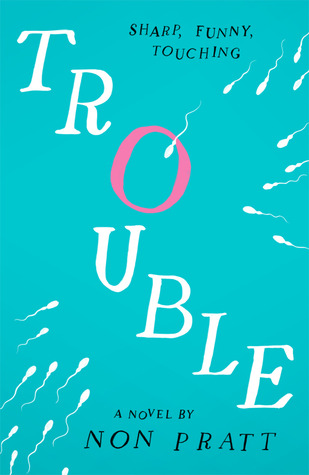
Trouble by Non Pratt

YA readers are rather accustomed to having a story centralised around a relationship that characters want to happen, but doesn't always work out. In Trouble, we're presented with a different scenario, in which Hannah doesn't seem to have a single problem getting any guy that she wants (to an extent). What she wasn't ready for was what can happen afterwards.

The most well-known teen pregnancy story from the past few years is the film Juno. If you loved Juno, you'll be just as much in love with Trouble. While Trouble shares a similar funny yet poignant look at how a teen copes with pregnancy, the similarities end there.

Hannah is 15 and far more focussed on her social life than she is with her school work. But everything gets thrown to the wall when she discovers she's pregnant. She knows who the father is, but she's too afraid to tell anyone. And the fact her mother works in a health clinic constantly dealing with teen pregnancies doesn't make matters any easier for Hannah. But that's when Aaron steps in - a new boy at school who has no real interest in socialising with anyone, yet finds himself drawn to Hannah.

Aaron befriends Hannah and then agrees to say he's the father of the baby in order to keep her from getting into a stickier situation. It's not an easy friendship for either of them. While Hannah's struggles are more obvious, there is still the fact that she is unable to tell anyone who the real father is. What she doesn't expect is that Aaron carries just as many problems of his own, none of which he's willing to share with her.

Trouble may provide an insight into teen pregnancy, but its strength is in showing how a real friendship works through every difficulty, even the most extreme. It's a reminder that the people we surround ourselves with should be the ones we can turn to when everything goes wrong.

Thursday, 20 March 2014

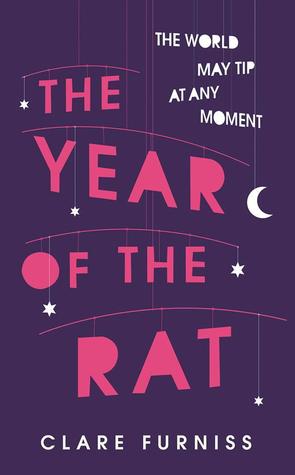
The Year of the Rat by Clare Furniss

I've had trouble writing this review. I kept coming back to it over the past week because I wasn't able to figure out what to say. It's a complex book with a not so happy topic, and I didn't want to write anything to make you think it's overly depressing and put you off reading it. In fact, I'll put the recommendation here first: read this book.

The Year of the Rat focuses on the first year after Pearl's mother dies in childbirth, but the baby (which Pearl henceforth calls the Rat) survives. Pearl and her step-father, who is the biological father of the Rat, are then left to deal with the situation: both grieving and taking care of a new baby.

While really it's no one's fault, it is a situation where one could easily place blame or feel guilt. Pearl, struggling with the loss of her mother, retreats into herself. Her best friend can't possibly understand, her step-father seems more concerned about his new child, and all Pearl can do is blame the Rat for causing the whole horrible mess. She seems to emotionally flit between different stages of grief depending on her situation: Pearl is clearly depressed, but she is also angry with her new sister to the point of such hatred that you begin to wonder if she'll ever warm to the baby.

What I loved most about this book is that while it was very much focused on an unhappy topic, it manages to maintain some humour. Despite her depression, Pearl can be funny in her own way. It really comes out during the exchanges she has/remembers with her mother. I think her mother's character is what makes this story, even though the story is clearly based around her absence, everyone else is focused on various traits of Pearl's mother as they begin to cope with her death.

As already mentioned, I highly recommend The Year of the Rat. This is a strong debut from a very talented author, looking at how people cope with grief and depression while life continues around them. It's an emotional but worthwhile journey complimented by superb writing.

The Year of the Rat publishes on 24th April by Simon & Schuster.

Tuesday, 11 March 2014

Forgive Me, Leonard Peacock by Matthew Quick

If you haven't heard of Matthew Quick, you will have heard of Silver Linings Playbook, the film based on his book of the same name. His recently-published Forgive Me, Leonard Peacock has some similar elements in that it focuses on a character that is suffering from psychological trauma. The real difference, though, is how Leonard Peacock chooses to deal with it.

While the story is mostly linear, present-day Leonard is continually focussing on the past as a way to explain his behaviour. It is his 18th birthday, and he has decided to kill himself, but not until after he's given the four people who mean something to him a small goodbye gift. Then he's going to kill Asher Beal before turning the gun on himself. As he acts through his plan, he looks back on how each of those four people has come to be what he considers a friend, with his thoughts interspersed by letters he has written to himself from the future.

At the onset, it's all rather disturbing, particularly if you are aware of just how often shootings happen in America, or just how easy it can be for teens to get access to guns. Leonard never expresses the desire to kill anyone other than Asher and himself, but you never know. Yet during the whole book you get the sense that Leonard doesn't really want to go through with it. He thinks he is really giving everyone the signs to show something is not right with him; he wants someone to notice. He wants people to pay attention to him. The problem is that no one is ever there to notice, as his mother spends most of her time away from home leaving Leonard essentially living by himself.

Despite his obvious faults, Leonard is a likable character. He's funny, thoughtful and even charming at times. This may seem out of sync with the dark things going on in his head, but it does go to show how complex we are as humans, and how most people only get to see a small side of any individual. Forgive Me, Leonard Peacock is a great example of a teenager who feels ostracized by everyone around him, and how he has attempted to rationalise extreme behaviour in reaction to feeling so alone, but can't quite let go as easily as he would like to.

Friday, 7 March 2014

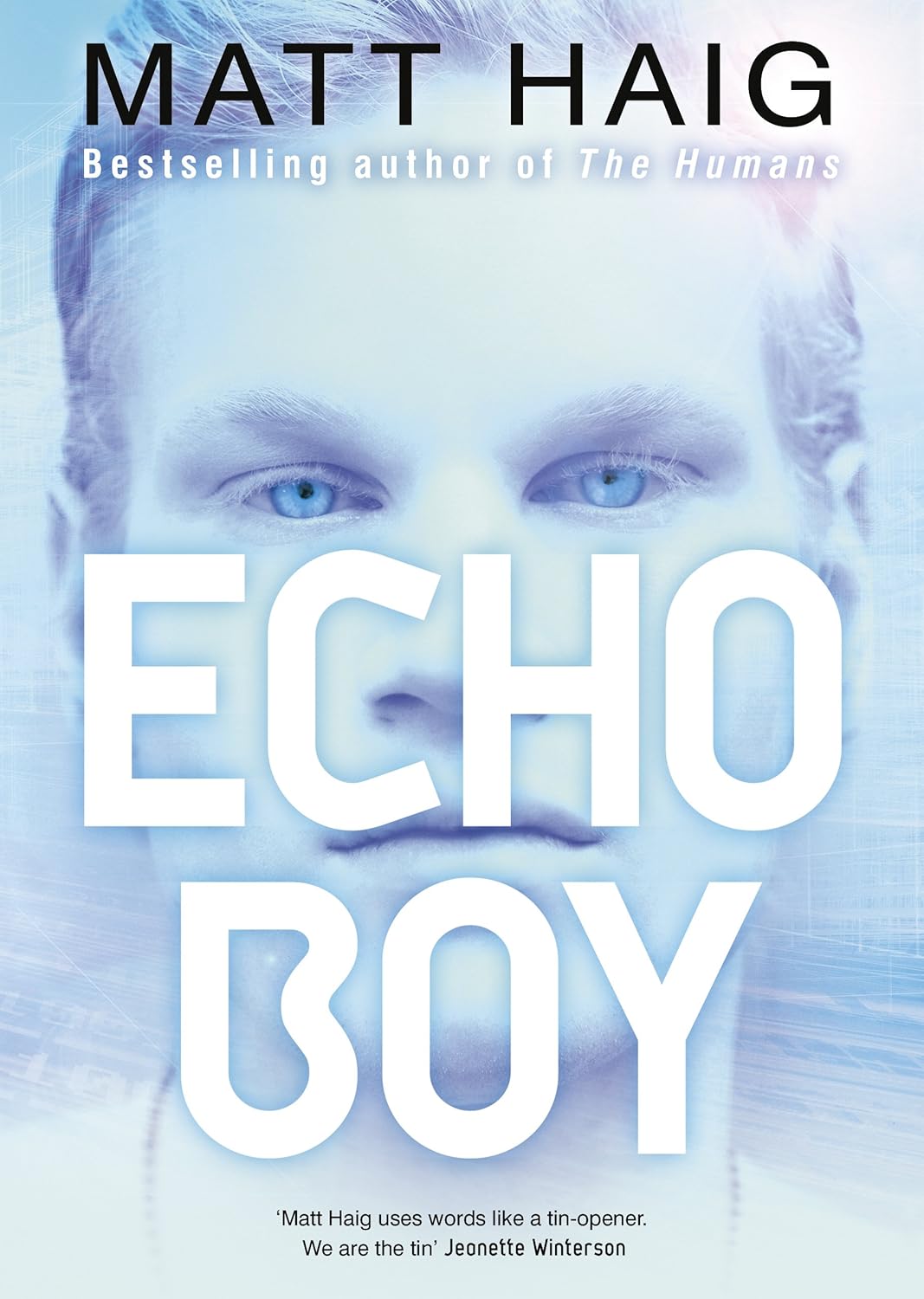
Echo Boy by Matt Haig

From the moment I started Echo Boy, I didn't want to put it down. And that was annoying, because I had a very busy week, so my sleep has suffered a bit. But the joy of reading this book was worth those lost hours of sleep. 


Echo Boy takes place in the future - not so distant that it seems impossibly far away, but long enough that it's possible and believable. In This future, the planet has been ravaged by extreme weather. Most of the UK is underwater, but despite these seemingly severe problems, humans have adapted amazingly well by developing new technologies. Houses are built on stilts, transport is on elevated magrails, and lifespan has improved immensely. The most noticeable technological advancements, though, are the Echos (Enhanced Computerised Humanoid Organisms): biological machines made of flesh and blood like a human, but still very robotic in manner. They have no ability to feel emotions or even disobey commands. But aside from these cognitive differences, they are more life-like than any other machinery that has ever existed. While many people in this world see the technological developments as a benefit to society, there are just as many people who are concerned and even scared for the future of humanity as these machines become increasingly intelligent.

Audrey's father is one of those who is strongly against the new technologies, actively writing about and protesting against developments. Yet it's his brother and Audrey's uncle, Alex Castle, who is at the helm of the all-powerful Castle Industries, driving these technological developments. And it's when Audrey ends up in her uncle's home that she meets Daniel - an Echo who doesn't seem quite right. His stare isn't blank like other Echos, and he seems to keep trying to tell her something.

What impressed me most with Echo Boy was Haig's desire to work out what it truly means to be human, and at what point is something classified as being "alive". Haig has a real understanding of how humans feel and portray emotion, and also how confusing certain feelings can be, particularly when they go against all logic. This is a book that you can really get into and enjoy, even though it may leave you asking much bigger questions. Echo Boy is a gripping read, not just for the need to find out what will happen, but discovering why everything else has. 

Echo Boy is published on March 27th by Bodley Head, a division of Random House Children's Publishers

Friday, 28 February 2014

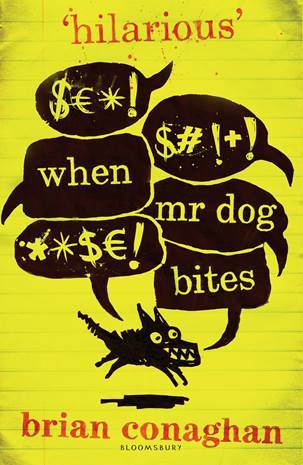
When Mr Dog Bites by Brian Conaghan

A few weeks ago the Telegraph published an article centred around When Mr Dog Bites, questioning whether children's books should come with recommended reader age warnings. You can read the article here, and the response of Bloomsbury Publishing Director Rebecca McNally here. It began a fascinating debate on social networks, prompting a lot of strong views. The reason for the language and some sexual discussion is quite obvious: the story is being narrated by a 16-year-old boy with Tourette's. I truly enjoyed the debate about profanity in children's books, and I do believe authors and editors only include it when it is truthful and necessary to the character and story. But if you want to read more about those debates, feel free to follow the links above. Needless to say, it was all this discussion that led to me reading the book, wanting to know what the fuss was about.

Dylan Mint is a likable character who, despite his Tourette's, isn't really all that different from other kids his age. He wants to have sex with the prettiest girl in his school, he wants to make sure his best friend is happy, and he wants his dad to come home from the war. But Dylan knows he is different, he knows he's at a school for people with disabilities, and he is all too aware of his own struggle with Tourette's. He tries to control it, but sometimes he can't and that's when "Mr Dog" comes out. He doesn't like his Tourette's, is embarrassed and apologetic to others for it, and then he hears the doctor say he's going to die in March. This springs Dylan to take action on making sure he does everything he really wants before March, leading to hilarious results and shocking discoveries.

There was one scene in When Mr Dog Bites that upset me, and not from the profanity, but due to how "normal" kids treated Dylan just because of his disability. They took advantage of him, and they wanted to exploit his Tourette's, his embarrassment, for their own amusement. It disturbed me because I saw the exact same thing happen many times while growing up. The school system I went to was different from Dylan's in that it was inclusive of children with mental and physical disabilities. They were in classes with all other children up until a certain age, and while they eventually were separated from us to attend their own classes, they were very much a part of our school and a part of the school's social events. I remember watching, horrified, as a group of teenage boys pushed a boy with mental disabilities to shout words he didn't understand, then laughing hysterically at the result. It was awful to experience in real life, and reading it from Dylan's perspective just made it more obvious as to how some people actually think it's funny when someone else has a disability, particularly one like Dylan's where he'll lose control and shout curse words. It's a type of bullying, and one I felt was addressed in the book particularly well.

When Mr Dog Bites is a book that doesn't just captivate and entertain, but really makes you think. Should someone like Dylan be treated any differently because of his condition? Does treating him differently make things better or worse for him? Would a more inclusive environment for teens with mental disabilities help them, or maybe even help other people understand the problems they face any better? Sure there's more swearing in this book than a standard YA novel, but to focus on that would be to miss the point. In a time where we're finally beginning to openly discuss mental health it's great to have a character like Dylan Mint who is able to face the demon that is his Tourette's and not let it ruin his life. He sets his goals at the beginning of the book and he doesn't give up. Like anyone else, Dylan may have his faults, but he seems to accept them in a way that is truly admirable.

As clearly stated on the back of the book, this isn't for younger readers. You can purchase When Mr Dog Bites from Bloomsbury here.
Tuesday, 18 February 2014

Jane, the Fox and Me by Fanny Britt and Isabelle Arsenault

Have you ever found a book that is just so beautiful you don't really care what it's about? Because that's how I felt the moment I saw the illustrations of Jane, the Fox and Me by Fanny Britt and Isabelle Arsenault, translated from French by Christelle Morelli and Susan Ouriou. It's great to see such a gorgeous graphic novel that not only appeals to girls, but addresses the issues that so many find they deal with during adolescence: self-esteem and physical appearance.

Helene has not had it easy at school. All of her former friends have abandoned her, and now entertain themselves by writing insults about Helene on the bathroom walls, or saying it out loud when they know she can hear. Their attacks on her appearance make Helene incredibly self-conscious, to the point she believes everything they say about her. It's a heartbreaking story seeing how a young girl can allow unkind and untrue words to alter her view of herself as well as the world around her. But Helene finds some relief in reading Jane Eyre, seeing how Jane grew up to be a beautiful intelligent woman, despite being a lonely orphan in her youth. As the bullying continues, it's not shocking to see how Helene retreats further into herself, and she begins to think that while Jane Eyre might have been lucky, it won't be true for herself.

This is a poignant story showing a different side of the person being bullied. We are introduced not to the typical victim who feels they are constantly being wronged, but one who actually believes what her tormentors say is true. Even if you cannot empathise with Helene, you may begin to realise that what you say to others really can affect how they view themselves. At least, I hope this is what young girls will take away from this story, and I think that providing it in a graphic novel format will potentially appeal to those girls who might not generally read. The illustrations provide the real sense of isolation that Helene experiences, with the sparing use of colour bringing the hope she initially lacks.


Walker Books have clearly put a lot of thought into the production of this book, getting the design spot on. Their close attention to matching the cover and the end papers to the colours of the illustrations really brings the whole book together in a spectacular presentation. (The copy I bought also had a fantastic fresh from the printer smell!) It's worth owning this title if not for the illustrations but for reminder of how much our words can mean to someone. This is a lesson that unfortunately seems to be reiterated to children and teens, but here, rather than being said it is shown through the emotion-provoking illustrations. If only there were more graphic novels as impressive and appealing to young girls as this one!
You can buy Jane, the Fox and Me directly from Walker Books on their website here.

Friday, 7 February 2014

Tinder by Sally Gardner

Perhaps I'm lucky that I didn't read many fairy tales as a child. Aside from seeing the Disney versions, I never bothered with them. With two older sisters and TV shows that always referred to classic literature, I was too fixated on reading above my level by the age of 10, and completely missed out on tween and YA books. A degree in English literature got all of those classics out of my system (well, maybe not all of them), and now I've been able to rediscover the joys of fairy tales.

The funny thing about most fairy tales, though, is that they can be dark, morbid and even disturbing. Most of us are aware that the original classic fairy tales have been subjected to modern reworks that make them what Disney would classify as child-friendly. Sometimes they are scary, but it's rare to encounter one now that doesn't have a happy ending. 

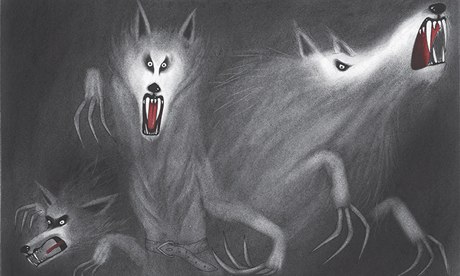
Then comes Tinder, Sally Gardner's fairy tale based on Hans Christian Andersen's The Tinderbox. It has everything an older reader, YA or adult, could possibly want to cleanse happily-ever-after from the system: chivalry, magic, werewolves, violence, seduction and deception. The story begins shortly after our protagonist Otto escapes the horrors of war, and while recovering he meets the beautiful red-haired Safire. Once she disappears, he knows he will do anything to find and marry her. But his quest takes him to dark and mysterious places, to the land of the werewolves, where he is suddenly entangled in the magic and curses that surround Safire's family.

This book is a great read, made particularly wonderful with illustrations by David Roberts. The gorgeous design and sparing use of colour (only black, white and red), make this haunting story worth owning - even if only to look at the pictures. The design is what drew me in, and I picked it up not knowing what to expect. The story itself did surprise me: this is very much not a children's fairy tale, especially with being quite frank about Otto wanting to sleep with Safire. At the end of the book Gardner points out that she wishes there were more illustrated books published for an older audience. I certainly share the sentiment, and I hope to see more books of this nature and quality in the future. 


Monday, 3 February 2014

Eleanor & Park by Rainbow Rowell

When I first saw the cover for Eleanor & Park I wasn’t sure it was for me. It’s not that I’m put off by romance; I just tend not to pick up a book that is purely based around a relationship. But I bought it on impulse due to the Waterstones “buy one get one half off” dilemma that I almost always have in Waterstones. The title had just been given a Printz Honor Award so it was fresh in my mind at the book shop the other week, and I’m pleased to say this wasn’t like any other teen romance title I’ve read before. In fact, it’s one of the most refreshing.

Eleanor has just arrived at a new school. She’s moved back in with her mother and step-father after being kicked out of their house previously. She’s chubby, has flaming red hair and a strange sense of style due to being restricted to thrift-shop buys and hand-me-downs. She is not the sort of person who you would expect to be a love interest, but that’s what happen when Park lets her sit with him on the bus. At first, Park isn’t too sure about Eleanor, and she doesn’t seem too fond of him. But when he notices her reading his comic books during their bus ride, they start to interact more, and eventually have a conversation.

This book is possibly the best I’ve read in capturing how it really feels to be a teenager falling in love for the first time. It’s awkward, it’s exciting and everything suddenly seems so different. Just holding someone’s hand is shocking and thrilling, but eventually not enough. The story is split to follow both Eleanor and Park’s perspectives. And while their relationship drives the story forward, the horrors of Eleanor’s family slowly unravel and start to affect every aspect of her life, even when she tries to keep them separate.

This is an incredibly touching story and well worth all the praise it’s received. It is easy to forget how you felt with your first love, but also amazing how easily those feelings come back when reading this book. (I admit to having several moments of grinning and feeling like a giddy teenager again.) Rainbow Rowell has done an incredibly job with Eleanor & Park, giving us a well-written story that perfectly displays the emotions and struggles of both teenage love and difficult family life.


Sunday, 5 January 2014

A Monster Calls by Patrick Ness

I was introduced to Patrick Ness's work through World Book Night, when a friend gave me The Knife of Never Letting Go (part 1 in the Chaos Walking trilogy). I loved it, and the whole trilogy, which led me on to read more of Ness. The title I was most looking forward to was A Monster Calls, and for good reason.

There are a few editions you can find of this title. I ended up getting the illustrated edition, because if there is an illustrated edition of anything, that tends to be what I go for. Illustrated by the incredibly talented Jim Kay (who has just been commissioned to illustrate the Harry Potter series), this is a title where you absolutely must get the illustrated edition to fully appreciate the beauty of the story.

As clearly detailed in the forward of the book, Ness was given an original idea by the late Sibohan Dowd, who unfortunately died before she was able to write the story. Simply put, the story is about a teenage boy, Conor, struggling with everyday life while his mother battles terminal cancer. He awakens one night from a recurring nightmare, only to find a monster outside his bedroom window. The monster continues to visit Conor, pushing the boy to come to terms with his mother's situation.

The book itself is short, but Ness is masterful with his writing, putting so much into each scene, each character, you feel he accomplishes so much in 200 pages. It's funny, tender and heartbreaking, with Kay's ink illustrations setting a perfect mood for the text. There is far more I could say about this amazing book, but I don't want to spoil it for anyone. Just do yourself a favour and make sure you get the illustrated edition.


You can purchase the illustrated paperback from publisher Walker Books here: A Monster Calls by Patrick Ness