If you haven't heard of Matthew Quick, you will have heard of Silver Linings Playbook, the film based on his book of the same name. His recently-published Forgive Me, Leonard Peacock has some similar elements in that it focuses on a character that is suffering from psychological trauma. The real difference, though, is how Leonard Peacock chooses to deal with it.
While the story is mostly linear, present-day Leonard is continually focussing on the past as a way to explain his behaviour. It is his 18th birthday, and he has decided to kill himself, but not until after he's given the four people who mean something to him a small goodbye gift. Then he's going to kill Asher Beal before turning the gun on himself. As he acts through his plan, he looks back on how each of those four people has come to be what he considers a friend, with his thoughts interspersed by letters he has written to himself from the future.
At the onset, it's all rather disturbing, particularly if you are aware of just how often shootings happen in America, or just how easy it can be for teens to get access to guns. Leonard never expresses the desire to kill anyone other than Asher and himself, but you never know. Yet during the whole book you get the sense that Leonard doesn't really want to go through with it. He thinks he is really giving everyone the signs to show something is not right with him; he wants someone to notice. He wants people to pay attention to him. The problem is that no one is ever there to notice, as his mother spends most of her time away from home leaving Leonard essentially living by himself.
Despite his obvious faults, Leonard is a likable character. He's funny, thoughtful and even charming at times. This may seem out of sync with the dark things going on in his head, but it does go to show how complex we are as humans, and how most people only get to see a small side of any individual. Forgive Me, Leonard Peacock is a great example of a teenager who feels ostracized by everyone around him, and how he has attempted to rationalise extreme behaviour in reaction to feeling so alone, but can't quite let go as easily as he would like to.
Tuesday, 11 March 2014
Friday, 7 March 2014
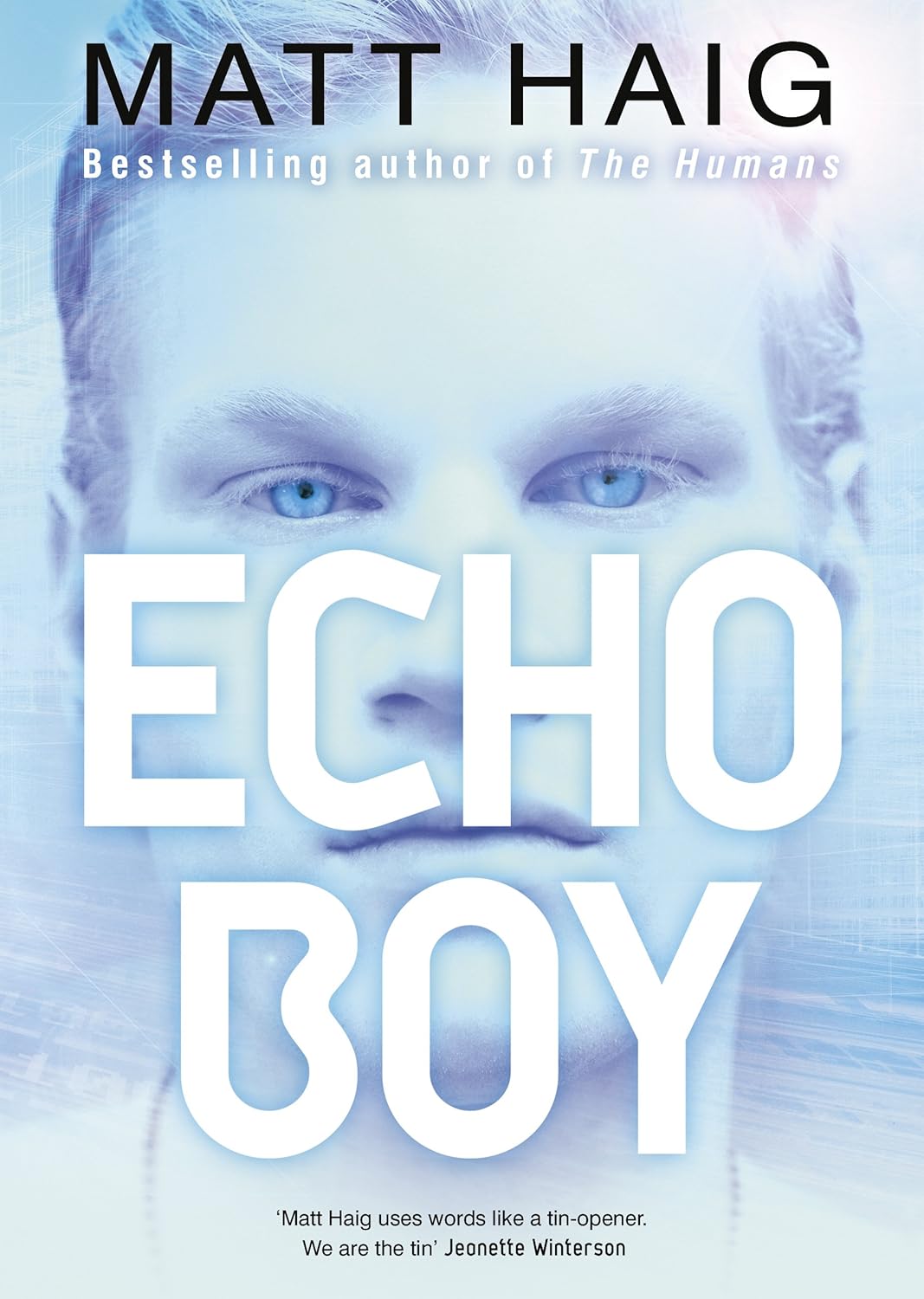
Echo Boy by Matt Haig
From the moment I started Echo Boy, I didn't want to put it
down. And that was annoying, because I had a very busy week, so my sleep has
suffered a bit. But the joy of reading this book was worth those lost hours of sleep.
Echo Boy takes place in the future - not so distant that it
seems impossibly far away, but long enough that it's possible and believable. In This future, the planet
has been ravaged by extreme weather. Most of the UK is underwater, but despite
these seemingly severe problems, humans have adapted amazingly well by
developing new technologies. Houses are built on stilts, transport is on
elevated magrails, and lifespan has improved immensely. The most noticeable technological
advancements, though, are the Echos (Enhanced Computerised Humanoid Organisms): biological machines made of flesh
and blood like a human, but still very robotic in manner. They have no ability to feel emotions or even disobey commands. But aside from these cognitive differences, they are more life-like than any other machinery that has ever existed. While many people in this world see the technological developments as a benefit to society, there are just as many people who are concerned and even scared for the future of humanity as these machines become increasingly intelligent.
Audrey's father is one of those who is strongly against the new technologies, actively writing about and protesting against developments. Yet it's his brother and Audrey's uncle, Alex Castle, who is at the helm of the all-powerful Castle Industries, driving these technological developments. And it's when Audrey ends up in her uncle's home that she meets Daniel - an Echo who doesn't seem quite right. His stare isn't blank like other Echos, and he seems to keep trying to tell her something.
What impressed me most with Echo Boy was Haig's desire to work out what it truly means to be human, and at what point is something classified as being "alive". Haig has a real understanding of how humans feel and portray emotion, and also how confusing certain feelings can be, particularly when they go against all logic. This is a book that you can really get into and enjoy, even though it may leave you asking much bigger questions. Echo Boy is a gripping read, not just for the need to find out what will happen, but discovering why everything else has.
Echo Boy is published on March 27th by Bodley Head, a division of Random House Children's Publishers
Friday, 28 February 2014
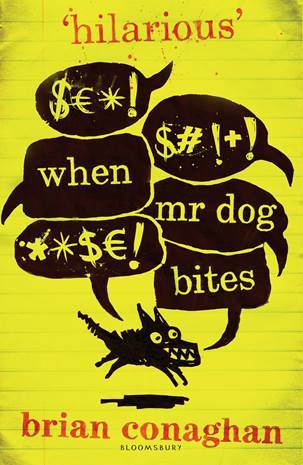
When Mr Dog Bites by Brian Conaghan
A few weeks ago the Telegraph published an article centred around When Mr Dog Bites, questioning whether children's books should come with recommended reader age warnings. You can read the article here, and the response of Bloomsbury Publishing Director Rebecca McNally here. It began a fascinating debate on social networks, prompting a lot of strong views. The reason for the language and some sexual discussion is quite obvious: the story is being narrated by a 16-year-old boy with Tourette's. I truly enjoyed the debate about profanity in children's books, and I do believe authors and editors only include it when it is truthful and necessary to the character and story. But if you want to read more about those debates, feel free to follow the links above. Needless to say, it was all this discussion that led to me reading the book, wanting to know what the fuss was about.
Dylan Mint is a likable character who, despite his Tourette's, isn't really all that different from other kids his age. He wants to have sex with the prettiest girl in his school, he wants to make sure his best friend is happy, and he wants his dad to come home from the war. But Dylan knows he is different, he knows he's at a school for people with disabilities, and he is all too aware of his own struggle with Tourette's. He tries to control it, but sometimes he can't and that's when "Mr Dog" comes out. He doesn't like his Tourette's, is embarrassed and apologetic to others for it, and then he hears the doctor say he's going to die in March. This springs Dylan to take action on making sure he does everything he really wants before March, leading to hilarious results and shocking discoveries.
There was one scene in When Mr Dog Bites that upset me, and not from the profanity, but due to how "normal" kids treated Dylan just because of his disability. They took advantage of him, and they wanted to exploit his Tourette's, his embarrassment, for their own amusement. It disturbed me because I saw the exact same thing happen many times while growing up. The school system I went to was different from Dylan's in that it was inclusive of children with mental and physical disabilities. They were in classes with all other children up until a certain age, and while they eventually were separated from us to attend their own classes, they were very much a part of our school and a part of the school's social events. I remember watching, horrified, as a group of teenage boys pushed a boy with mental disabilities to shout words he didn't understand, then laughing hysterically at the result. It was awful to experience in real life, and reading it from Dylan's perspective just made it more obvious as to how some people actually think it's funny when someone else has a disability, particularly one like Dylan's where he'll lose control and shout curse words. It's a type of bullying, and one I felt was addressed in the book particularly well.
When Mr Dog Bites is a book that doesn't just captivate and entertain, but really makes you think. Should someone like Dylan be treated any differently because of his condition? Does treating him differently make things better or worse for him? Would a more inclusive environment for teens with mental disabilities help them, or maybe even help other people understand the problems they face any better? Sure there's more swearing in this book than a standard YA novel, but to focus on that would be to miss the point. In a time where we're finally beginning to openly discuss mental health it's great to have a character like Dylan Mint who is able to face the demon that is his Tourette's and not let it ruin his life. He sets his goals at the beginning of the book and he doesn't give up. Like anyone else, Dylan may have his faults, but he seems to accept them in a way that is truly admirable.
As clearly stated on the back of the book, this isn't for younger readers. You can purchase When Mr Dog Bites from Bloomsbury here.
Dylan Mint is a likable character who, despite his Tourette's, isn't really all that different from other kids his age. He wants to have sex with the prettiest girl in his school, he wants to make sure his best friend is happy, and he wants his dad to come home from the war. But Dylan knows he is different, he knows he's at a school for people with disabilities, and he is all too aware of his own struggle with Tourette's. He tries to control it, but sometimes he can't and that's when "Mr Dog" comes out. He doesn't like his Tourette's, is embarrassed and apologetic to others for it, and then he hears the doctor say he's going to die in March. This springs Dylan to take action on making sure he does everything he really wants before March, leading to hilarious results and shocking discoveries.
There was one scene in When Mr Dog Bites that upset me, and not from the profanity, but due to how "normal" kids treated Dylan just because of his disability. They took advantage of him, and they wanted to exploit his Tourette's, his embarrassment, for their own amusement. It disturbed me because I saw the exact same thing happen many times while growing up. The school system I went to was different from Dylan's in that it was inclusive of children with mental and physical disabilities. They were in classes with all other children up until a certain age, and while they eventually were separated from us to attend their own classes, they were very much a part of our school and a part of the school's social events. I remember watching, horrified, as a group of teenage boys pushed a boy with mental disabilities to shout words he didn't understand, then laughing hysterically at the result. It was awful to experience in real life, and reading it from Dylan's perspective just made it more obvious as to how some people actually think it's funny when someone else has a disability, particularly one like Dylan's where he'll lose control and shout curse words. It's a type of bullying, and one I felt was addressed in the book particularly well.
When Mr Dog Bites is a book that doesn't just captivate and entertain, but really makes you think. Should someone like Dylan be treated any differently because of his condition? Does treating him differently make things better or worse for him? Would a more inclusive environment for teens with mental disabilities help them, or maybe even help other people understand the problems they face any better? Sure there's more swearing in this book than a standard YA novel, but to focus on that would be to miss the point. In a time where we're finally beginning to openly discuss mental health it's great to have a character like Dylan Mint who is able to face the demon that is his Tourette's and not let it ruin his life. He sets his goals at the beginning of the book and he doesn't give up. Like anyone else, Dylan may have his faults, but he seems to accept them in a way that is truly admirable.
As clearly stated on the back of the book, this isn't for younger readers. You can purchase When Mr Dog Bites from Bloomsbury here.
Labels:
Bloomsbury,
Brian Conaghan,
family,
mental health,
Tourette's,
When Mr Dog Bites,
YA
Wednesday, 19 February 2014
The Last Wild by Piers Torday
I have to admit that when I picked up a copy of The Last Wild I didn't know anything about it. I do not know how I had missed it for so long, and I'm rather ashamed I did. The reason I did pick it up was for two simple lines on the back of the book:
Kester is a boy living inside a quarantine zone. The world outside has become dangerous due to the Red Eye virus that has run rampant and killed out all the wildlife - except the animals known as vermin (pigeons, rats, cockroaches). Contact with any animal is avoided, in case they are carrying the deadly Red Eye. But soon Kester, who hasn't been able to speak for years, discovers he can communicate with the pigeons and even the cockroach who help him make a dramatic escape back into the quarantine zone. And it's here that Kester learns the truth: not all of the animals have died. There are only a few left, and their numbers are dwindling as they are ravaged by the disease. But they now have a human who they can talk to, who they can convince to help them find a cure for the Red Eye, so that the last remaining wild can be saved.
Rather amusingly, I had been trying to avoid dystopian books for a while. After The Hunger Games, it seemed like there were too many showing up on the market with very little to offer. So I'm incredibly pleased I wasn't aware this was a dystopian book, otherwise I would not have picked it up, and I would have missed out on a brilliant story.
I wondered what pigeons would say if they could talk, so I bought the book with no other expectations.1. There is a flock of excited pigeons in his bedroom.
2. They are talking to him.
Kester is a boy living inside a quarantine zone. The world outside has become dangerous due to the Red Eye virus that has run rampant and killed out all the wildlife - except the animals known as vermin (pigeons, rats, cockroaches). Contact with any animal is avoided, in case they are carrying the deadly Red Eye. But soon Kester, who hasn't been able to speak for years, discovers he can communicate with the pigeons and even the cockroach who help him make a dramatic escape back into the quarantine zone. And it's here that Kester learns the truth: not all of the animals have died. There are only a few left, and their numbers are dwindling as they are ravaged by the disease. But they now have a human who they can talk to, who they can convince to help them find a cure for the Red Eye, so that the last remaining wild can be saved.
Rather amusingly, I had been trying to avoid dystopian books for a while. After The Hunger Games, it seemed like there were too many showing up on the market with very little to offer. So I'm incredibly pleased I wasn't aware this was a dystopian book, otherwise I would not have picked it up, and I would have missed out on a brilliant story.
This is a great book for readers who are interested in dystopian fiction, but perhaps not old enough to get into the more popular YA titles of this genre or want to avoid the ones that are particularly dark. That's not to say those who enjoy the YA titles won't enjoy The Last Wild - in fact, they may find it a refreshing take on dystopias. With adventure and hints at fantasy, this book is a great read with a strong message about the importance of wildlife and nature. Kester is a fascinating lead character who will appeal to both boys and girls. The animals who accompany him are equally fantastic and quite comical at times.
The Last Wild has just been listed on the Waterstones Children's Book of the Year shortlist, and its sequel, The Dark Wild, is due out at the beginning of April. So it's time to start reading it if you haven't already. You can buy The Last Wild from Quercus books here.
Labels:
adventure,
animals,
dystopia,
middle grade,
nature,
Piers Torday,
Quercus,
The Last Wild
Tuesday, 18 February 2014
Jane, the Fox and Me by Fanny Britt and Isabelle Arsenault
Have you ever found a book that is just so beautiful you don't really care what it's about? Because that's how I felt the moment I saw the illustrations of Jane, the Fox and Me by Fanny Britt and Isabelle Arsenault, translated from French by Christelle Morelli and Susan Ouriou. It's great to see such a gorgeous graphic novel that not only appeals to girls, but addresses the issues that so many find they deal with during adolescence: self-esteem and physical appearance.
Helene has not had it easy at school. All of her former friends have abandoned her, and now entertain themselves by writing insults about Helene on the bathroom walls, or saying it out loud when they know she can hear. Their attacks on her appearance make Helene incredibly self-conscious, to the point she believes everything they say about her. It's a heartbreaking story seeing how a young girl can allow unkind and untrue words to alter her view of herself as well as the world around her. But Helene finds some relief in reading Jane Eyre, seeing how Jane grew up to be a beautiful intelligent woman, despite being a lonely orphan in her youth. As the bullying continues, it's not shocking to see how Helene retreats further into herself, and she begins to think that while Jane Eyre might have been lucky, it won't be true for herself.
This is a poignant story showing a different side of the person being bullied. We are introduced not to the typical victim who feels they are constantly being wronged, but one who actually believes what her tormentors say is true. Even if you cannot empathise with Helene, you may begin to realise that what you say to others really can affect how they view themselves. At least, I hope this is what young girls will take away from this story, and I think that providing it in a graphic novel format will potentially appeal to those girls who might not generally read. The illustrations provide the real sense of isolation that Helene experiences, with the sparing use of colour bringing the hope she initially lacks.
Walker Books have clearly put a lot of thought into the production of this book, getting the design spot on. Their close attention to matching the cover and the end papers to the colours of the illustrations really brings the whole book together in a spectacular presentation. (The copy I bought also had a fantastic fresh from the printer smell!) It's worth owning this title if not for the illustrations but for reminder of how much our words can mean to someone. This is a lesson that unfortunately seems to be reiterated to children and teens, but here, rather than being said it is shown through the emotion-provoking illustrations. If only there were more graphic novels as impressive and appealing to young girls as this one!
You can buy Jane, the Fox and Me directly from Walker Books on their website here.
Helene has not had it easy at school. All of her former friends have abandoned her, and now entertain themselves by writing insults about Helene on the bathroom walls, or saying it out loud when they know she can hear. Their attacks on her appearance make Helene incredibly self-conscious, to the point she believes everything they say about her. It's a heartbreaking story seeing how a young girl can allow unkind and untrue words to alter her view of herself as well as the world around her. But Helene finds some relief in reading Jane Eyre, seeing how Jane grew up to be a beautiful intelligent woman, despite being a lonely orphan in her youth. As the bullying continues, it's not shocking to see how Helene retreats further into herself, and she begins to think that while Jane Eyre might have been lucky, it won't be true for herself.
This is a poignant story showing a different side of the person being bullied. We are introduced not to the typical victim who feels they are constantly being wronged, but one who actually believes what her tormentors say is true. Even if you cannot empathise with Helene, you may begin to realise that what you say to others really can affect how they view themselves. At least, I hope this is what young girls will take away from this story, and I think that providing it in a graphic novel format will potentially appeal to those girls who might not generally read. The illustrations provide the real sense of isolation that Helene experiences, with the sparing use of colour bringing the hope she initially lacks.
Walker Books have clearly put a lot of thought into the production of this book, getting the design spot on. Their close attention to matching the cover and the end papers to the colours of the illustrations really brings the whole book together in a spectacular presentation. (The copy I bought also had a fantastic fresh from the printer smell!) It's worth owning this title if not for the illustrations but for reminder of how much our words can mean to someone. This is a lesson that unfortunately seems to be reiterated to children and teens, but here, rather than being said it is shown through the emotion-provoking illustrations. If only there were more graphic novels as impressive and appealing to young girls as this one!
You can buy Jane, the Fox and Me directly from Walker Books on their website here.
Monday, 17 February 2014
Darcy Burdock: Hi So Much by Laura Dockrill
If you've not been introduced to the world of Darcy Burdock, now is the time to change that. With the second book in the series, Hi So Much., due to be published on February 27th, Darcy Burdock is rapidly becoming the "it" girl in tween fiction. She's funny, she's creative, and she's what some might call overly-dramatic (but isn't that all tween girls?). I can see so much of my ten-year-old self in her, and I'm sure everyone will be able to relate to Darcy in one way or another.
I first saw Laura Dockrill during a talk at the British Library about children's literature, and it was her enthusiasm about books, especially those she read during her childhood, that really made her stand out. (Okay, her neon pink tights may have helped with that as well.) She was such a fascinating speaker that it only made sense to check out her work, which is how I was introduced to Darcy Burdock.
The books are written from Darcy's point of view, in Darcy's manner of speaking and way of thinking. It can take some getting used to, but it's worth it as Dockrill has perfectly captured youth in this character. Darcy is made more interesting by her ability to write creative stories that relate to her life and even provides illustrations. It's a difficult feat for an author to have a character who writes, and also include the character's stories within a book, but with Darcy it only seems natural and necessary.
In the second installment, Hi So Much sees Darcy enter the Big School, where everything is different. It encompasses the difficulties of the tween age: whether or not you can be best friends with a member of the opposite sex, how to cope with life when tragedy strikes, and how there are always people you can depend on, even when you don't expect it. But most importantly, even with all the ups and down dramas of Darcy's life, her reaction is realistic of a ten-year-old. You can only sympathise with all her pains and take pleasure in her joys. The book is, quite simply, a really fun read.
What I truly loved about this book was how many people in Darcy's life would suggest she write, be it to cope with something or simply because they recognise a talent. There was no one ever pushing her too much or telling her not to, which is a wonderful reminder of how much a child can thrive if their interests are supported and they aren't regularly running into negativity. I feel any child reading about Darcy will not only appreciate everything she experiences, but also be inspired to be creative in some way. At least, this is what I can only hope, because I know that if I had read this as a ten-year-old girl, I would have wanted to be best friends with Darcy, and also wanted to write stories of my own.
Darcy Burdock: Hi So Much. publishes on the 27th of February. Buy now direct from Random House here.
I first saw Laura Dockrill during a talk at the British Library about children's literature, and it was her enthusiasm about books, especially those she read during her childhood, that really made her stand out. (Okay, her neon pink tights may have helped with that as well.) She was such a fascinating speaker that it only made sense to check out her work, which is how I was introduced to Darcy Burdock.
The books are written from Darcy's point of view, in Darcy's manner of speaking and way of thinking. It can take some getting used to, but it's worth it as Dockrill has perfectly captured youth in this character. Darcy is made more interesting by her ability to write creative stories that relate to her life and even provides illustrations. It's a difficult feat for an author to have a character who writes, and also include the character's stories within a book, but with Darcy it only seems natural and necessary.
In the second installment, Hi So Much sees Darcy enter the Big School, where everything is different. It encompasses the difficulties of the tween age: whether or not you can be best friends with a member of the opposite sex, how to cope with life when tragedy strikes, and how there are always people you can depend on, even when you don't expect it. But most importantly, even with all the ups and down dramas of Darcy's life, her reaction is realistic of a ten-year-old. You can only sympathise with all her pains and take pleasure in her joys. The book is, quite simply, a really fun read.
What I truly loved about this book was how many people in Darcy's life would suggest she write, be it to cope with something or simply because they recognise a talent. There was no one ever pushing her too much or telling her not to, which is a wonderful reminder of how much a child can thrive if their interests are supported and they aren't regularly running into negativity. I feel any child reading about Darcy will not only appreciate everything she experiences, but also be inspired to be creative in some way. At least, this is what I can only hope, because I know that if I had read this as a ten-year-old girl, I would have wanted to be best friends with Darcy, and also wanted to write stories of my own.
Darcy Burdock: Hi So Much. publishes on the 27th of February. Buy now direct from Random House here.
Labels:
Corgi,
Darcy Burdock,
Hi So Much,
Laura Dockrill,
middle grade,
Random House,
tween,
writing
Thursday, 13 February 2014
A House Without Mirrors by Mårten Sandén
I have already confessed once to enjoying a good translated book. I should also now confess that I am rapidly becoming obsessed with Pushkin Press's children's list. A House Without Mirrors is the second Pushkin Press book I've read, and it certainly won't be the last.
The story is told from the perspective of the 11-year-old Thomasine, who lives in a large house with her relatives and her dying great-aunt Henrietta. Her father spends the majority of his time caring for the elderly woman, while her aunt and uncle seem to be more interested in how to split the inheritance once Henrietta does die. Thomasine's cousins have their faults as well: vanity, shyness and trouble-making.
With a slight nod to Narnia, the children discover a wardrobe where all the mirrors in the house were hidden. Yet when they step inside, rather than being taken to another world, they are transported to another time in a mirror image of the same house.
The story is supplemented with beautiful illustrations by Moa Schulman. The style of the book itself may appear to be aimed at younger children, and while they can certainly enjoy the story, an older child and certainly an adult can appreciate the difficulty of love and grief that Thomasine and her family experience.
Translated from Swedish by Karin Altenberg and published by Pushkin Press, Mårten Sandén's A House Without Mirrors is not one to be missed. It is a fascinating look at how we all have an inner struggle, and what could happen if we only face it.
The story is told from the perspective of the 11-year-old Thomasine, who lives in a large house with her relatives and her dying great-aunt Henrietta. Her father spends the majority of his time caring for the elderly woman, while her aunt and uncle seem to be more interested in how to split the inheritance once Henrietta does die. Thomasine's cousins have their faults as well: vanity, shyness and trouble-making.
With a slight nod to Narnia, the children discover a wardrobe where all the mirrors in the house were hidden. Yet when they step inside, rather than being taken to another world, they are transported to another time in a mirror image of the same house.
The story is supplemented with beautiful illustrations by Moa Schulman. The style of the book itself may appear to be aimed at younger children, and while they can certainly enjoy the story, an older child and certainly an adult can appreciate the difficulty of love and grief that Thomasine and her family experience.
Translated from Swedish by Karin Altenberg and published by Pushkin Press, Mårten Sandén's A House Without Mirrors is not one to be missed. It is a fascinating look at how we all have an inner struggle, and what could happen if we only face it.
Subscribe to:
Posts (Atom)